Wednesday, October 17, 2007

The Second Largest Collective It'kaaf in the World ...


For several years now, Minhaj-ul-Quran's It'kaaf has been the second largest collective It'kaaf in the World, second only to the It'kaaf held at Haram Sharif in Saudi Arabia. We were expecting about fifteen to twenty thousand participants this year, but all were pleasantly surprised by the actual turnover: thirty-seven thousand men and women, about one-third women (12,000) and two-thirds men (25,000), all gathered for the remembrance of Almighty God. Participants came from every corner of Pakistan. We also had several hundred participants from all over the world - from Europe, America, Central Asia, Afghanistan, and India.


I could not sit in the It'kaaf due to an evil combination of professional and family issues, but I did sit as a volunteer doctor in one of the dispensaries for the Mu'takifeen from Asr to Isha. There is something special about serving the guests of God: one becomes a guest himself. For me, the most memorable time of the It'kaaf came when Qibla Shaikh-ul-Islam said that he was pleased with the performance of the Medical Committee and announced a special gift for the doctors who gave voluntary services at the dispensaries. Can you guess what that gift was? It was Irfan-ul-Quran, which is Qibla Shaikh-ul-Islam's translation of the Quran in Urdu along with the Arabic text. I have never received a more beautiful gift in my entire life.


Thursday, September 13, 2007

Crisis of Faith …

I never liked Mother Teresa’s guts. To excel in positive deeds and be hailed as one of the foremost humanitarians of the age and yet not have even a mustard seed of imaan, that is the kind of person she was. She has given empirical evidence for what is already known in Islam, that a person could be saturated in the glamour of good works and yet be among those who have lost favor with God. I will not claim to know the ultimate fate of Mother Teresa but the darkness she describes is certainly the darkness of disbelief:

As for those who disbelieve, their deeds are like a mirage in a desert. The thirsty one thinks it to be water, until he comes up to it, he finds it to be nothing, but he finds God with him, Who will pay him his due [Hell]. And God is swift in taking account. Or [the state of a disbeliever] is like the darkness in a vast deep sea, overwhelmed with a great wave topped by a great wave, topped by dark clouds, darkness, one above another, if a man stretches out his hand, he can hardly see it! And he for whom God has not appointed light, for him there is no light. (Qur'an: The Light, verses 39-40)


When one turns away from the darkness of disbelief towards the brightness of Islamic Enlightenment, one comes across three layers of enlightenment, as described in the Hadith of Jibreel, namely Imaan (Faith), Islaam (Practice), and Ihsaan (Islamic Renaissance).

Many people falter at the step of Imaan. Some move on to Islaam. And a lucky few achieve the stage of Ihsaan. But why would a person who was practicing Islaam bang his head against the wall?:

The tergiversations of her faith reminded me of my own, I guess. Although I’m outwardly religious, I’ve never had the intimate relationship with Allah that I see others possess- I envy those brothers. So many times I’ve wished I was more like them, and so many times I’ve wished for death. Sometimes I hope that my execution might redeem me- maybe Allah would forgive me if I suffered a painful and ignominious death. I remember praying fajr many, many times and hitting my head against the wall, and praying to Allah desperately for faith. I’ve never prayed more sincerely in my life.

So I understand where she’s coming from. A mind wracked by doubt- to the point that it’s painful. I’m pleased with Allah as my Lord, Islam as my religion etc- but I’m weak.

(An anonymous comment at this page.)


Apparently this person had Imaan and was practicing Islaam, but he (or she) consistently failed to achieve that spiritual state called Ihsaan, so he banged his head against the wall.

Question: Why could he not achieve Ihsaan?
Answer: Because he was suffering from a Crisis of Faith.

We live in an age where Islam is under vicious attack from all sides and angles. We live in an age where Wahhabism and Qadyanism are making inroads. We live in an age where the Muslim community is thoroughly fragmented. We live in an age where we are surrounded by enemies from all sides, enemies who have incredible economic, military, and media power at their disposal. We live in an age where extremes of poverty and prosperity are making people lose their Imaan. We live in an age where women are being encouraged to lose their veils and the billboards are displaying pornography instead of displaying advertisements. We live in an age of excellence in science, technology, and secular knowledge, yet the Muslim countries are those who are most lagging behind in these fields. We live in an age where the mullah has done everything possible to destroy the image of Islam.

Faith enters a stage of crisis when one is living in such an Islamophobic milieu. For someone aspiring to achieve Ihsaan, it is extremely important that he should know what Faith is. Faith (Imaan) begins with the statement:

There is no deity but God
Muhammad is the Messenger of God

In fact, Faith (Imaan) is more than just a statement - it is a belief. It entails belief in not one but two personalities:

1. God (glorified He is)
2. Muhammad (peace be upon him)

In the age in which we live, people have concentrated on the first part of the Statement of Faith, but have forgotten the significance of the second part of the statement. In other words, people do realize that God is the only deity, but they have underestimated the supreme and beloved status of Prophet Muhammad (peace be upon him). That this happened is not surprising when one observes the fall of scholarship in the Muslim lands coupled with the rise of orientalism in the non-Muslim lands.

Talking about the Prophet, saying nasheeds in his remembrance, remembering his voice, his manner of speaking, his way of walking, his way of talking, his way of smiling, his exalted character, his intelligence, his intellect, his beauty, his hair, his eyes, his fingernails - this is Islam. I remember during my college days, no one talked about Muhammad, peace and blessings be upon him. All they talked about was girls, girls, and girls. They had their excuses candy-coated by the enemies of God - that sexual attraction was normal, that it was okay to talk about girls (and not okay to not talk about girls), that it was also okay to have sex with them (as long as you used a condom) and blah blah blah. I yearned for someone who would talk freely and enthusiastically about Prophet Muhammad – peace and blessings be upon him.

Islam is not only about the Worship of God, it is also about the Love of Muhammad. In fact, the Islamic creed does not differentiate between the Worship of God and the Love of Muhammad. That is indeed what the Statement of Faith is: the belief that the Worship of God and the Love of Muhammad are one and the same thing.

For those wanting to know more about the Beloved, here is an interesting article about him.

I will end this rant with one of the most beautiful verses of nasheed in the whole of Urdu poetry:

شوق ترا اگر نہ ہو میری نماز کا امام
میرا قیام بھی حجاب میرا سجود بھی حجاب

Translation:

If your Love is not the Imam of my Prayer
Then my standing is a veil, my prostration is a veil
(Allama Iqbal)

Friday, July 13, 2007

The Lal Masjid Tragedy …

Minhaj-ul-Quran's press release on the Lal Masjid tragedy is in Urdu, so here is my English translation of the press release for my English-speaking readers:


Shaikh-ul-Islam, Dr Tahir-ul-Qadri, has said that the Lal Masjid tragedy has caused severe damage to the image of Islam and Pakistan on an international level. Those who work to clarify the real concept of Islam will have to move forward with wisdom and foresight, and in this connection, the scholars especially will have to recognize their responsibilities. He said that the damage incurred to the international image of Islam due to the Lal Masjid issue should be a cause of concern to every Muslim. There is no place in Islam for extremist and terrorist methodologies or myopic viewpoints. He was delivering a telephonic address to the monthly congregation of the Majlis Khatam Salat-un-Nabi (peace be upon him) at the ground opposite the Central Secretariat of Minhaj-ul-Quran yesterday, which was attended by thousands of men and women. Shaikh-ul-Islam, Dr Tahir-ul-Qadri said that the difficulties of expatriate Pakistanis and the Ummah would increase due to the Lal Masjid tragedy. The baseless conception of Muslims as extremists and terrorists will get stronger. In these conditions, the responsibility falls on the Ummah and the scholars to play their role in spreading the true teachings of Islam based on peace, forbearance, love, and religious tolerance. To meet the challenges faced by Islam on an international level, it is imperative that an organized effort be made on a collective level against the evil conspiracies bent upon associating negative extremist methodologies with Islam so that the negative propaganda against Islam is countered. He said that the picture of Islam the world saw with respect to the Lal Masjid issue has no link whatsoever with the real teachings of Islam. Minhaj-ul-Quran Movement is playing an important role in spreading the real teachings of Islam in the whole world, and in five continents of the world, people are playing their peaceful and constructive roles in their respective societies after coming into contact with the Islamic message of love and peace. Shaikh-ul-Islam said that struggle should be done on individual and collective levels against the false anti-Islamic propaganda so that the real peace-loving face of Islam is shown to humanity. In this connection, the scholars of Minhaj-ul-Quran are playing their roles effectively as ambassadors of peace and harmony. He said that Pakistan is an extremely important country of the Muslim world that has the full potential to provide leadership to the Muslim world. That is why anti-Islamic forces are bent upon weakening it in every respect. Events like the Lal Masjid have severely damaged its image as potential leader of the Muslim world. In the future, the public will also have to play their role in preventing such irresponsible, negative events. Shaikh-ul-Islam, Dr Tahir-ul-Qadri, said that Minhaj-ul-Quran is a worldwide movement for the Renaissance of Islam. The rejuvenation of the culture of Knowledge is a responsibility that falls on Minhaj-ul-Quran. Knowledge does not bring positive results without Practice. Prostration changes Knowledge into Light. So it is important that apart from the Practice of always sending blessings to the Holy Prophet (peace and blessings be upon him), the seeking of Knowledge and the Practicing of that Knowledge should be kept uppermost in one’s priorities. He said that the Muslim Ummah should put its efforts in the quest of Knowledge. Minhaj-ul-Quran Movement is working in the whole world on raising awareness about the acquisition of Knowledge. Knowledge becomes Gainful Knowledge after Practice and the Practice of getting up in the night to prostrate before God changes Knowledge into Light and confers an inner light to a person that gives him or her success in this Life and the Hereafter.

Monday, April 02, 2007

Do You Recognize This Man? ...

Do you really know who Muhammad is? (Alayhes salat o wassalam.) Muhammad is the man whose sweat was used as the best perfume you would come across. Muhammad is the man whose stool was more fragrant than the food he ingested - such was the effect of contact with his heavenly body. Muhammad is the man whose face radiated beauty like the full moon so that Mother Ayesha could locate her lost needle in the night. Subhanallah!

Oftentimes I hear people - Muslims and non-Muslims alike - speaking of the Holy Prophet, sallallah-o-alaihe-wassallam, never really knowing who they are talking about. But anywayz, who can dare know who Muhammad is? "The reality of your Prophet is known by God alone", so said the Prophet, upon whom be infinite blessings and peace. The glorious Qur'an reciprocated: "Wa Ma Muhammad Illa Rasool" ("And what is Muhammad but the Messenger?" - Qur'an, 3:144). I have always been struck by the fact that the Qur'an used the word Ma ("What") and not Man ("Who"). Subhanallah!

As we celebrate God's Gift to Mankind, let us take all the time to know more about who the Prophet is - sallallah-o-alaihe-wassallam. Death is just round the corner, and I can't wait for the time when they will ask me, "Do you recognize this man?", and - hopefully, hopefully, hopefully - I'll respond with the words, "Wa Ma Muhammad Illa Rasool".

Peace and blessings be upon you, O icon of beauty and wonder, and upon your family, your companions, and all those who love you.

Friday, January 26, 2007

Empty Vessels Make the Most Noise …

The Day of Ashura is drawing near. Some people will come decked out in black clothes and hurt themselves in an act of sadomasochism that has no link whatsoever with the patience and sacrifice of Hussain (alaihes salam) at the Battle of Karbala. Empty vessels, it is said, make the most noise. If we want to love Hussain, let us do what he did and stand up against the Yazids of our times. Let us be those who fought under Hussain and not those who betrayed him at the last moment. For a change, how about starting off with fighting the rebellious nafs that we have developed within our own selves?

Sunday, January 07, 2007

The Tragedy of the Human Condition …

Surah Fatiha (“The Opening”), the first surah of the Holy Qur’an, can be thought of as an introduction or preface to the Qur’an. It is also the best summary of the Holy Qur’an. Because of its ubiquitous use in various prayers, a practicing Muslim will typically recite this surah about one million times in his or her lifetime. It is a must-read for all people, regardless of their faith:


بِسْمِ اللهِ الرَّحْمنِ الرَّحِيمِِ
In the name of God, the Beneficent, the Merciful

الْحَمْدُ للّهِ رَبِّ الْعَالَمِينَ
Praise be to God, Lord of the Worlds

الرَّحْمـنِ الرَّحِيمِ
The Beneficent, the Merciful

مَالِكِ يَوْمِ الدِّينِ
Master of the Day of Judgment

إِيَّاكَ نَعْبُدُ وإِيَّاكَ نَسْتَعِينُ
You [alone] we worship; and You [alone] we ask for help

اهدِنَــــا الصِّرَاطَ المُستَقِيمَ
Show us the straight path

صِرَاطَ الَّذِينَ أَنعَمتَ عَلَيهِمْ غَيرِ المَغضُوبِ عَلَيهِمْ وَلاَ الضَّالِّينَ
The path of those whom You have favored; not the [path] of those who earn Your anger nor of those who go astray


Surah Fatiha contains a vast store of knowledge, wisdom, and understanding. But my thoughts get concentrated on its most poignant verse, the last one:


صِرَاطَ الَّذِينَ أَنعَمتَ عَلَيهِمْ غَيرِ المَغضُوبِ عَلَيهِمْ وَلاَ الضَّالِّينَ
The path of those whom You have favored; not the [path] of those who earn Your anger nor of those who go astray


It means that there are three categories of people:

1. Those who have earned God’s favor
2. Those who have earned God’s disfavor
3. The lost souls

I look around myself in this world of six billion souls and I see people belonging to the latter two categories. Then I take a telescope and manage to see a few men and women - just a few - who belong to the first category. Then I take a mirror and I see myself. I stand rooted to the spot, thunderstruck by the reflection that stares back at me. I am horrified. Stupefied. And finally disgusted. I turn away from the mirror. The world inside me is a reflection of the world outside me.

Man has lived in vain.

Sunday, December 17, 2006

More Polemics on the Sun and the Earth: Is the Qur’an Geocentric or Heliocentric? …

It is He Who has made the Sun a shining thing and the Moon as a light and measured out its [their] stages, that you might know the number of years and the reckoning. God did not create this but in truth. He explains the Signs in detail for people who have knowledge.
(Al-Qur’an: 10:5)


When one surfs the Internet, one comes across a plethora of websites and discussion forums that accuse the Qur’an of Biblical geocentrism. Their charge is that the Qur’an is presenting a cosmology wherein the heavenly bodies, in particular the Sun and the Moon, are revolving around a fixed and immobile Earth. Their main argument in favor of this allegation is that the Qur’an never mentions that the Earth is moving while it often mentions that the Sun and the Moon are moving. Truly, the Qur’an does say at various places that the Sun and the Moon “run on their fixed courses for an appointed term” (Qur’an: 13:2, 14:33, 31:29, 35:13, 36:38, 39:5, and 55:5) or “float, each in an orbit” (Qur’an: 21:33 and 36:40). However, as we shall see shortly, there is a cosmic ignorance and prejudice that lurks behind the Islamophobic manner of thinking. It is extremely unfortunate that the apology put forward by some well meaning but uninformed Muslims reveals similar cosmic ignorance. The Muslim apology that I have come across consists of two main arguments:

1. The Qur’an is not a Book of Science; rather, it is a Book of Signs. Therefore, one should not expect to find a statement about the movement of the Earth in the Qur’an.
2. If the Qur’an does not mention the movement of the Earth around the Sun, neither does it say that the Sun moves around the Earth. All it says is that the Sun “moves”. That’s all. It does not define the orbit of the Sun. Modern science has found out that the Sun is indeed moving – around the center of our galaxy. Hence, modern science has vindicated what the Qur’an had revealed 1400 years ago.

In all humbleness, I think what we have here is a classic case of a strong case but a weak lawyer. Neither of these arguments directly addresses the allegation of the Islamophobes. We will insha’Allah offer a refutation of the accusation here. Before we go into deeper matters, we will first debunk the hoax of the fixed abode.


The Hoax of the “Fixed Abode”:

The Holy Qur’an says:

Is not He [better than your gods] Who has made the earth as a fixed abode, and has placed rivers in its midst, and has placed firm mountains therein, and has set a barrier between the two seas? Is there any god with God? Nay, but most of them know not. (27:61)

The Islamophobic inference is that the Qur’an is saying that the Earth is fixed and immobile. Here are three other standard translations:

Is not He [best] Who made the earth a fixed abode … (Pickthall)
Or, Who has made the earth firm to live in … (Yusufali)
Or, Who made the earth a resting place … (Shakir)

The word fixed vanishes in two translations because the Qur’anic word qararan has been used to describe the Earth in a geologic context and not in an astronomic context. This becomes most obvious when the verse in question is studied in context with the preceding verse:

Is not He [better than your gods] Who created the heavens and the earth, and sends down for you water [rain] from the sky, whereby We cause to grow wonderful gardens full of beauty and delight? It is not in your ability to cause the growth of their trees. Is there any god with God? Nay, but they are a people who ascribe equals [to Him]! Is not He [better than your gods] Who has made the earth as a fixed abode, and has placed rivers in its midst, and has placed firm mountains therein, and has set a barrier between the two seas. Is there any god with God? Nay, but most of them know not. (27:60-61)

One will observe in these verses that after mentioning “the heavens and the earth”, which is the Qur’anic terminology for the Universe, the Qur’an immediately moves on to focus on the Earth’s geologic phenomena. The phenomena are mentioned in this order:

1. Rain
2. Gardens
3. Trees
4. Earth (fixed abode / resting place)
5. Rivers
6. Mountains
7. Seas

It is obvious that the word ardh is not used here to refer to a planet of the solar system; instead, it is used here to refer to the Earth’s crust. The Qur’an is simply saying that the Earth’s crust has been made stable enough for man to live on it. The discerning eye of some sick devil saw the words earth and fixed placed tantalizingly close to each other in a standard translation, and so he or she decided it was time to wreak havoc on the Internet.


Sunrise and Sunset:

We commonly say, “The Sun rises in the East”, and “The Sun sets in the West”. The words rise and set are verbs attributed to the Sun, thus implying that the Sun is moving, yet we use these words despite the fact that we have deduced from certain observations and experiments that sunrise and sunset occur because of the spinning of the Earth on its axis and not revolution of the Sun around the Earth. We use these verbs without causing any ambiguity because we know that we are talking only about the phenomena of appearance of the Sun from below the horizon and disappearance of the Sun beneath the horizon rather than actual movement of any heavenly body.

The Qur’an uses the same methodology (e.g., Qur’an: 2:258, 6:76-78, 18:17) and it would be dishonest to fish out a diagnosis of biblical geocentrism on the basis of this usage in the Qur’an. In particular, Dhul Qurnayn’s story has been used by the Islamophobes to allege that the Prophet Muhammad, upon whom be infinite blessings and peace, thought that the Sun went around a fixed Earth. The same holds true for the Hadith of the Throne. (See my previous post for details.)


Frames of Reference and The Problem With Newtonian Mechanics:

Due to our early indoctrination with Newtonian mechanics, the statement, “The Earth revolves around the Sun”, has been so deeply ingrained in our mentality that we fail to see that this statement is prejudicial and holds true only if the Sun is taken as the frame of reference. Newtonian mechanics erroneously held that space is Euclidean and thus space itself is an absolute frame of reference, and this is why the Qur’an is being seen in the wrong light.

Einstein’s theories of relativity, which are a cosmic shift from Newtonian mechanics, hold that space is curved by heavenly bodies. The consequence is that there is no absolute or privileged frame of reference. Thus the statement, “The Earth revolves around the Sun”, made by an observer on the Sun, and the statement, “The Sun revolves around the Earth”, made by an observer on the Earth, are both true from their own perspectives. One of the most important discoveries of Relativity is that description of the motion of heavenly bodies necessarily calls for an arbitrary frame of reference. The Qur’an has thus chosen to take the Earth as the frame of reference for the simple reason that this is where we live and do our observations. This indeed is why the Qur’an does not care to describe the movement of the Earth. It is, however, extremely important to note that the Qur’an takes the Earth only as a convenient frame of reference, not as a privileged or absolute frame of reference. This has had two consequences. Firstly, the Earth is nowhere described as a still, motionless object. Secondly, although the Sun and the Moon are described as moving objects, this movement is never defined to be around the Earth. In this context, the mistake of the Bible was not that it adopted a geocentric frame of reference. Rather, the Bible’s mistake was to assume that the geocentric frame is a privileged frame.

The Holy Qur’an has adopted four positions with regard to the movement of the heavenly bodies:
1. The Sun and the Moon are said to be moving.
2. The movement of the Sun and Moon is described as being in a “fixed course”, but the course is not described as being around the Earth.
3. The Earth is not said to be moving.
4. The Earth is not said to be stationary either (i.e. the Qur’an has preferred to remain silent about the movement or lack of movement of the Earth in an astronomic context.)

As we have seen, all this is perfectly consistent with the general principles of Relativistic mechanics. Now, there is a fifth and final point about the movement of the heavenly bodies that is most interesting. The Qur’an describes the motion of the Sun and the Moon by the phrase
كُلٌّ فِي فَلَكٍ يَسْبَحُونَ (Qur’an, 21:33, 36:40) which means “they float, each in an orbit”. When an object floats in water, it drifts along gently on the surface of the water. In other words, the object goes wherever the medium in which it has been placed (water) carries it. Likewise, heavenly bodies move in curved orbits because it is the curvature of the space in which the body is moving that carries the body into a curved orbit. Thus the Qur’anic description is most appropriate.

It has now becomes a matter of Faith to decide whether it is Relativity that is vindicating the Qur’an or the Qur’an that is vindicating Relativity.

Sunday, November 26, 2006

Some Polemics on the Sun and the Earth …


In a postmodern world where the Sun of Christianity is found to be setting in murky waters, one finds the Sun of Islam rising on a people for whom no protection has been provided against the bright sunshine of Islamic Enlightenment. Hence, Islamophobia runs amok. They say that people who live in glass houses should not throw stones at others, but it seems like the Christian missionaries are hell-bent on “proving” that Prophet Muhammad, upon whom be infinite blessings and peace, was laboring under the illusion that the Earth is flat and the Sun rotates around a stationary earth. I believe that a hundred lies cannot equal a single truth, yet this is precisely what the missionary agenda is. Here we will insha’Allah offer a refutation of the accusations leveled against the Qur’an and Sunnah.


The Story of Dhul-Qarnayn:

The Holy Qur’an says:

And they ask you about Dhul-Qarnayn. Say: "I shall recite to you something of his story." Verily, We established him in the earth, and We gave him the means of everything. So he followed a way. Until, when he reached the setting place of the Sun, he found it setting in a spring of black muddy [or hot] water. And he found near it a people. We [God] said [by inspiration]: "O Dhul-Qarnayn! Either you punish them, or treat them with kindness." He said: "As for him who does wrong, we shall punish him; and then he will be brought back unto his Lord; Who will punish him with a terrible torment [Hell]. But as for him who believes and works righteousness, he shall have the best reward, [Paradise], and we [Dhul-Qarnayn] shall speak unto him mild words [as instructions]." Then he followed another way, Until, when he came to the rising place of the Sun, he found it rising on a people for whom We [God] had provided no shelter against the Sun. So [it was]! And We knew all about him [Dhul-Qarnayn]. (Al-Qur’an, 18:83-91)

The accusation is that Dhul-Qarnayn (and by extrapolation, Prophet Muhammad, peace be upon them) thought that the Earth was flat and he had reached the literal ends of the Earth where he observed the Sun entering inside a spring of murky water at the Western end (!) and the Sun rising so close to the Earth at the Eastern end that there was no protection for the people who lived there. An accusation couldn’t get more ludicrous. In this connection, the Wikipedia articles on Sunrise and Sunset are most enlightening. The Sunrise article notes:

The apparent westward revolution of Sun around the Earth after rising out of the horizon is due to the Earth's eastward rotation. This illusion is so convincing that most cultures had mythologies and religions built around the geocentric model.

While the Sunset article notes in the last sentence of its third paragraph:

On a west-facing coastline, sunset occurs over water while sunrise occurs over land.

If a modern writer who believes that sunset and sunrise are illusions, can say a statement like “sunset occurs over water” or “sunrise occurs over land”, then why can’t the Author of the Qur’an say so?

It may be noted that we popularly call Japan as the Land of the Rising Sun even though we know that the Earth is spherical and rotates around the Sun. Indeed, the Japanese call their country Nippon, a word that means “origin of the Sun”.

Sunset Boulevard in Los Angeles, California (in the United States) is probably the most famous street in the World. The western part of this street - its most famous part - is duly named Sunset Strip. It runs near Los Angeles’ western coastline adjoining the Pacific Ocean. The Qur’anic reference to "the setting place of the Sun" is indeed such a place in Dhul-Qarnayn’s kingdom. The “spring” of murky water may or may not have been an ocean, but it certainly was large enough to extend all the way to the horizon.


Flattened Earth vs Flat Earth:

The Qur’an says:

And it is He who spread out the Earth (13:3)
And the Earth, We spread out
(15:19)
And the Earth, We have spread it out
(50:7)
And We have spread out the Earth, how Excellent Spreader [thereof] are We!
(51:48)
And God has made for you the Earth, wide spread [an expanse]
(71:19)
And after that, He spread the Earth
(79:30)
And at the Earth, how it is spread out
(88:20)
And by the Earth and Him Who spread it
(91:6)

None of the verses quoted above preclude the Earth from being a big sphere. A surface that has been “spread out” could very well be a big spherical surface. Moreover, the spreading out could also mean the flattening (i.e. leveling) of the Earth after it was bombarded by flying fragments during the Late Heavy Bombardment. This bombardment probably created 22,000 or more craters with impact diameters greater than 20 km, about 40 impact basins with diameters about 1,000 km, and several impact basins with diameter about 5,000 km.


The Earth as a Bed:

The Qur'an says:

Who has made the Earth for you like a bed [or carpet] (20:53)
Who has made for you the Earth like a bed [or carpet] (43:10)
Have We not made the Earth as a bed [or carpet]
(78:6)

The accusation is that since beds are flat and not spherical, the Author of the Qur'an "thinks" that the Earth is flat, as opposed to spherical. However, geologists, who sleep in flat beds and believe in a spherical Earth, also believe that sedimentary rock, which covers 75% of the Earth’s surface and most of the continental land mass, has been laid down in layers called beds (1,2) through a process called bedding. More detailed reading of the verses in question will reveal that the the Qur’an has always referred to the Earth as a bed in a geologic (and not astronomic) context only:

Who has made the Earth for you like a bed [spread out]; and has opened roads [ways and paths, etc] for you therein; and has sent down water [rain] from the sky. And We have brought forth with it various kinds of vegetation (20:53)

Who has made for you the Earth like a bed, and has made for you roads therein, in order that you may find your way. And Who sends down water [rain] from the sky in due measure. Then We revive a dead land therewith, and even so you will be brought forth [from the dead]. (43:10-11)

Have We not made the Earth as a bed. And the mountains as pegs? (78:6-7)

The only valid inference we can draw is that the Qur’anic reference to the Earth as a bed is not only most appropriate, it is also far ahead of its time of revelation.


The Hadith of the Throne:

According to an authentic hadith of Sahih Bukhari:

Narrated Abu Dhar: The Prophet, peace be upon him, asked me at sunset, "Do you know where the sun goes (at the time of sunset)?" I replied, "Allah and His Apostle know better." He said, "It goes (i.e. travels) till it prostrates Itself underneath the Throne and takes the permission to rise again, and it is permitted and then (a time will come when) it will be about to prostrate itself but its prostration will not be accepted, and it will ask permission to go on its course but it will not be permitted, but it will be ordered to return whence it has come and so it will rise in the west. And that is the interpretation of the Statement of Allah: "And the sun Runs its fixed course For a term (decreed). that is The Decree of (Allah) The Exalted in Might, The All-Knowing." (36.38)

(Hadith referenced here.)

The significance of Syedna Abu Dhar’s statement (may God be pleased with him), “Allah and His Apostle know better”, should not be underestimated. It does not mean that Syedna Abu Dhar (may God be pleased with him) or the Arabs of the 7th century had no idea where the Sun went after setting. Rather, it was routine with the Companions to answer any question of the Prophet, peace be upon him, with these words even if they knew the answer, the only exception being when they realized that the Prophet, peace be upon him, was specifically demanding for an answer. This was because they knew what was meant by the term adab (i.e. love and reverence) of the Holy Prophet (peace be upon him). In this context, I am reminded of Shakespeare’s Taming of the Shrew, a fond memory from my childhood years, where Petruchio tames his spoiled wife to such an extent that when he points at the Sun and says that it is the Moon, she agrees with him, and when he says that it is not the Moon but the Sun indeed, she again agrees with him. I wish we too could learn such adab.

The phrase, “It goes (i.e. travels)” cannot be forced to mean that it travels around a fixed earth. Such an inference can be made if the words had been, “It goes on around the earth”. In the hadith, however, the phrase “It goes” simply means that it goes on in whatever orbit has been assigned to it.

The Sun prostrates when it reaches the Throne, yet in our scientific observation, the Sun is never seen to prostrate to any Throne. Instead, it is observed to be orbiting the center of our galaxy at a speed of about 800,000 kilometers per hour. The reason for our inability to observe the prostration of the Sun is that the Throne lies in the Unseen (the Gha'ib). The laws of physics hold true only in the physical universe (the Seen). The laws of the metaphysical universe (the Unseen) are known only to Almighty God or to whom He gives special sanction. It is not for us to speculate on the Unseen. Note also the following Qur’anic verses:

And to God prostate all things that are in the Heavens and all things that are in the Earth, of the live moving creatures and the angels, and they are not proud [i.e. they worship their Lord with humility] (16:49)

See you not that to God prostrates whoever is in the Heavens and whoever is on the Earth, and the Sun, and the Moon, and the stars, and the mountains, and the trees, and the live moving creatures, and many of humankind? But there are many [people] on whom the Punishment is justified. And whomsoever God disgraces, none can honor him. Verily! God does what He wills. (22:18)

And the herbs [or stars] and the trees both prostrate (55:6)

The manner in which all of the non-human creation prostrate to God is not observable to us through scientific methods because it is a matter of the Unseen that was shown only to the Prophet Muhammad, peace be upon him. Likewise, the prostration of the Sun is just as unobservable as the prostration of the trees and mountains.

This hadith is very important in that it underscores the fact that a Muslim is by definition one who believes in the Unseen:

Those who believe in the Unseen (Qur’an:2,3)

A Prophet is by definition one who brings news from the Unseen (nabi, the Arabic word for prophet, means ‘one who brings news’); a believer is one who listens to this news and believes in the truthfulness of the news-bringer, salla Allah o alaihe wa aaalehi wa sallam.


Reference: Hadiths on the Cosmos – On Cosmic Revolution, the Dying Sun, and Energy

Tuesday, October 24, 2006

The Strangeness of the Veil ...

The Holy Prophet (peace be upon him) said:

"Islam came a stranger to this world and will leave a stranger from this world."

(Hadith referenced here.)

There are very few statements that have the effect of reducing me to tears. This is one of them. I cry with tears every time I read or hear this hadith. If only some people could know what is the meaning of pain ...

But I don't cry when some secular person says that he feels uncomfortable with the feminine veil and then a whole nation joins him in chorus. When millions of people who are completely unfamiliar with the veil start casting aspersions on it and bicker about how the veil is so "strange", then know that the stranger has come and he is here to stay.

Ahlan wa sahlan, marhaba, marhaba.

Eid Mubarak :)

Wednesday, September 27, 2006

If You Are a Porn Addict …

Then this Ramadhan-ul-Mubarak is just right for you. Here are a few tips to get you off the hook …

  • Develop insight: That is, develop the understanding that you are indeed hooked on to the wrong thing. If you think that pornography is “OK”, then you’ll never develop your spiritual side, alas.

  • Develop motivation: Why do you want to get rid of your addiction? The best motivation is to do so for the sake of Almighty God and His Beloved Prophet (peace be upon him).

  • Avoid the wrong situations: As much as humanly possible, avoid those situations where porn is easily accessible, e.g. company with the wrong people, watching television, lone hours at the internet, etc.

  • Follow every bad act with a good one: Such as two nafl of prayers, or a sadaqa (charity).

  • Stay busy: An idle mind certainly is the devil’s workshop, so involve yourself in something constructive.

  • Say the five prayers: Be staunch on the five obligatory prayers. If you don’t pray them, then start NOW. Do it, no matter how hard it is for you. Even if you have to shower before every prayer. Try to do the fardh, sunnah, and nafl rak’ats, all of them.

  • Say the tahajjud prayer: No kidding here. Not only say the tahajjud prayer, but also spend some time crying before the Lord. If you can’t cry, then make a crying face (no kidding again). Such remembrance deep in the middle of the night will break the spell of the nafs and will work wonders for your overall personality.

  • Keep nafl fasts: Remember that fasting is one of the strongest ways to keep the sexual urges at bay. Fast on a daily basis in Ramadhan. In the other months, you may consider fasting every alternate day or every Monday or any other schedule that suits you. (However, fasting on a daily basis has been recommended against in months other than Ramadhan.)
  • Keep company with the Awliya (Friends of God) and the Sulaha (Pious People): At the very least, avoid company with people who will detract you.

  • Update (Jan 21, 2007): Please read this link on how to give up masturbation.

Wednesday, September 20, 2006

The Superior Logic of the Qur’an …


وَمَا رَمَيْتَ إِذْ رَمَيْتَ وَلَـكِنَّ اللّهَ رَمَى

“And you threw not when you threw, but it was God who threw”
[Qur’an, 8:17]


The verse of the Qur’an quoted above refers to the incident(s) when the Holy Prophet (peace be upon him) threw gravels or pebbles at the pagans in war and miraculously hit them individually in the eyes. The traditional exegesis of the verse is that since it is humanly impossible to achieve such a feat, Almighty God attributed this feat to Himself.

However, the sacred verse puts the logicians in a quandary since it could be broken into three statements that are apparently not mutually consistent:

(1) The Prophet (pbuh) threw the pebbles
(2) The Prophet (pbuh) did not throw the pebbles
(3) God threw the pebbles

The problem seems to lie with the fact that statement (1) and (2) are contradictory, and yet the Qur’an is acknowledging both statements within the same breath – “and you threw not when you threw”! While on the one hand, this apparent contradiction serves to detract the hard-hearted disbelievers, it also gives us a glimpse into the superior logic of the Qur’an.

The conflict can be easily resolved if one realizes that, broadly speaking, every object and every event has two realities: an apparent reality and a hidden reality. The apparent and the hidden realities are different and could seem to be contradictory, but this apparent contradiction is only because of change of perspective. The case in study – the event of throwing of the pebbles - also had two realities: an apparent one, namely throwing of the pebbles by the Holy Prophet (peace be upon him), and a hidden one, namely throwing of the pebbles by Almighty God (glorified be He). Both realities are true in their own perspective, and denial of any one is tantamount to kufr (disbelief). Thus, statements (1) and (3) quoted above are both true, while the conjunctive statement (2) prevents the literal equating of (1) with (3), an act that would be tantamount to shirk (associating partners with God).

But logic aside, this sacred verse is one of the most endearing expressions of love you would come across. They say that Love leaves Logic in its wake, so it is not surprising that the blessed Sufis, who immerse themselves in the hidden reality, have a way of understanding this verse that leaves the blind logicians in the proverbial dust. At the supreme height of Love, the Lover equates the action of the Beloved with his own, and says by way of explanation, “That action that you did, you know, I am the one who did it, not you”.

God bless the Sufis.

Saturday, September 09, 2006

The Schizophrenic Love of Some Conspiracy Theorists …


Some schizophrenic people create artificial quarrels between the Friends of God (Awliya Allah) and divide people on groundless grounds. Thus there are ostensible Sunnis who acknowledge the Khulafa Rashidun but deny the spiritual dominion of Syedna Ali (may God ennoble his face). On the other hand, there are ostensible Shias who allege fealty to Syedna Ali (may God ennoble his face) but accuse Syedna Abu Bakr, Umar, and Usman (may God be pleased with them) of usurping power. These extremely dangerous trends are borne out of an atmosphere of ignorance and prejudice.

In my observation, many people are simply confused. The confusion in their minds is in dire need of resolution. It is in this context that Sheikh-ul-Islam wrote his book, The Ghadir Declaration. The book is available online free of cost and is a must-read for the knowledge-seekers. The preface of the book resolves the conflict created by the conspiracy theorists.

Friday, September 01, 2006

Description of the Beloved …

I once posted on Umm-e-Ma’bad’s description of the Holy Prophet (peace be upon him). The portrayal is beautiful because of its use of metaphors. Yet it falls short of the mark precisely because of its use of metaphor. Syedna Pir Mehr Ali Shah (may God be pleased with him) was once blessed with a vision of the Holy Prophet (peace be upon him). He described the vision in a short, succinct Punjabi verse that said it all:

Koiy misl nahin dholan dee
Chup kar Mehr-e-Ali
Ethay jaa nahin bolan dee


Translation:

There is no metaphor for the Beloved
Be silent, O Mehr-e-Ali
This is no place for making similes!

Monday, August 28, 2006

Shock & Awe …


The quintessential Shock & Awe is the Conquest of Makkah. It took the Makkans by such complete and utter surprise that there was no room available for resistance. It ushered in the Prophetic Revolution.

When Prophet Musa (alaihes salam) and his people were caught between River Nile and the Pharaoh’s army, Syedna Musa (alaihes salam) struck the Nile with his staff and the river split into two walls, thus creating a passage for Syedna Musa (alaihes salam) and his people to pass. When they had crossed the river in this dramatic fashion, they were followed by the Pharaoh and his army in blind pursuit, who never realized that this river would become their grave. What ensued was Shock & Awe in its most shocking and most awesome form. Think about two walls crashing upon each other and you will know what I am talking about.

At Pakistan Awami Tehreek (Pakistan Peoples’ Movement), Shock & Awe is the technique that will usher Pakistan into Quaid-e-Azam’s vision of the modern, Islamic welfare country. In my previous posts, I have affirmed that Islamic Renaissance cannot be achieved without regaining political supremacy for Islam. This is the thought process that underlies the creation of Pakistan and this is the thought process that calls for a political renaissance in Pakistan and eventual union of the Muslim countries into an Islamic Bloc. Given the stronghold of corrupt, feudal, sectarian, terrorist, and exploitative elements in the country, we are obviously heading towards a final countdown with these forces of evil. We are already rapidly approaching critical mass and it will not be long till when we will simply explode into a spectacular display of Shock & Awe.

Some people are skeptical. Some are downright cynical. My response to them is: Do you remember the raging infernos in the oil wells of Kuwait way back in the Gulf War? The Iraqis set the oil wells on fire because they probably thought there would be no way the Americans could extinguish such violent flames. Yet it took only one big dynamite explosion per oil well to nip the evil. The technique is simple, yet elegant: You surround the fire with lots of dynamite and you explode the dynamite. There is a big explosion, a lot of dust, and lo and behold! Liquid oil gushes forth with no evidence of fire whatsoever. How does the technique work? They say that when the dynamite explodes, it creates a momentary vacuum for a split second, thus robbing the fire of its much-needed oxygen for a split second, and that is enough to extinguish the fire.

If you can believe in the spectacular extinguishing power of dynamite, why can’t you believe in the revolution promised by Sheikh-ul-Islam? After all, it takes only a split second to kill a monster fire. You just need the right amount of dynamite.

Wednesday, August 23, 2006

"Jinnah", the Movie ...

Few individuals significantly alter the course of history. Fewer still modify the map of the world. Hardly anyone can be credited with creating a nation. Mohammad Ali Jinnah did all three.
(Professor Stanley Wolpert)


Jinnah, the movie, begins with these words of eulogy in honor of Quaid-e-Azam, Muhammad Ali Jinnah, the founder of Pakistan. Jamil Dehlvi’s effort is a commendable one, partly because he brings forth a historically accurate picture of Jinnah and his times. Unlike Richard Attenborough’s Gandhi, which was a sadistic take on Jinnah, Dehlvi’s production presents its characters in a fairly balanced and neutral manner, seemingly guided by the principles of the man he seeks to portray, i.e. justice, fair play, and impartiality. Dehlvi presents the facts and events as they were and allows the audience to arrive at their own conclusions. However, this does not mean that Jinnah is a dry lesson in history. On the contrary, it is a very engaging account, with an element of fantasy sprinkled in the movie that not only serves to lighten the mood but also helps in eliciting Jinnah’s perspective.

The young Jinnah is convincingly played by Richard Lintern, who portrays Jinnah as the brilliant, self-respecting, and suave gentleman that he was. Dehlvi has skillfully balanced the cold, calculating, and astute Jinnah who dramatically dumb-witted his opponents in court and in politics, with the gentle and loving Jinnah who affectionately loved his sister and who dared a romantic escapade with the beautiful Ruttie. The elder Jinnah, played by Christopher Lee (again very convincingly), is shown to have matured into a statesman and a spokesperson for the Muslim community of India. As always, Jinnah is thoroughly self-respecting and will not settle for anything less than a separate country precisely because he believes it is the “only way” to self-respect. This perspective of Jinnah is effectively brought out in the following conversation that takes place between the viceroy, Lord Mountbatten, and the Quaid-e-Azam:

Mountbatten: Divide the country in two? Muslims on one side, Hindus on the other? Mr Jinnah and his madness!
Jinnah: No, Mountbatten. It would be equally insane to leave a Muslim minority at the mercy of a Hindu majority, many of who hate us. Now, if the English Parliament …
Mountbatten (cutting Jinnah short): The Prime Minister has given me full powers. I decide. That’s why I am here, as representative of the King Emperor.
Jinnah: Whom we respect. I am here as a representative of a Muslim nation whom you must learn to respect.

Some people have questioned the reasons for the creation of a separate Muslim state. They cite as arguments against the creation of Pakistan the genocides of 1947 and 1971, the secession of Bangladesh, the three wars fought over Kashmir, and the overall failure of successive Pakistani governments. Such spurious reasoning is the product of ignorance or sheer prejudice. Granted those are pathetic facts, but they do not serve as evidence against the creation of Pakistan. It would be dumb indeed to surmise that it would have been all flowers and sunshine if only we had remained part of a larger India. We should not forget Quaid-e-Azam’s incisive words in the conversation quoted above: “many of who hate us”. Yes, many of them hated us in the early twentieth century and many of them still hate us in the early twenty-first century. To be sure, it was this hatred that spurred the genocide of 1947; it was this hatred that conspired with the Soviet Union to incite the genocide of 1971; and it was this hatred that provided the ideological ammunition to fight three wars over Kashmir.

Though Quaid-e-Azam’s vision still lies in the future (albeit not-too-distant future – and that’s something which is the subject of my next post, insha’Allah), I would, for the moment, like to emphasize that Pakistan has the potential to spearhead the formation of an Islamic Bloc, a position it couldn’t hold if it were part of secular India. This alone is good enough reason for the creation of Pakistan, and woe to the disbelievers.

Who says that Pakistan is a failure, yet India is a success? For the record, allow me to mention that we are economically slightly better off than India (rates of abject poverty being significantly lower in Pakistan), we have very low prevalence of HIV/AIDS compared with India’s sky-high rates, and we have a cricket team that wins more often than it loses when it is in mortal combat with the Indians.

Long live Jinnah.

Thursday, August 17, 2006

Terrorism Has No Religion ...

"Terrorism has no religion. It is a social and criminal phenomenon caused by various reasons. Islam is based on plurality rather than individuality. It demands harmonization and integration."
(Sheikh-ul-Islam, Professor Dr Muhammad Tahir-ul-Qadri)


I just had to write this post, you know, just had to. You see, when proud lesbians become unflinching champions for Islam, then you know that something is amiss. Irshad Manji's latest trash is yet another pathetic attempt at making Muslims feel bad about themselves. I will not attempt to debunk Manji here coz she is nowhere near worth it, but one thing is clear: Such Islamophobic nonsense as hers does make an impact on the common Westerner (whatever a Westerner is). The acerbic responses to my previous posts on the topic of terrorism (1, 2) are evidence of this impact. The main thrust of my arguments in those posts was that it is hypocritical for the Western media to put the spotlight on Muslim terrorists when their own countries are committing terrorism of a far greater magnitude. But it seemed that my arguments were lost on the commentators at those posts. Evidently, they had bought into the story depicted by their media.

In connection with this mind-boggling phenomenon called terrorism, Sheikh-ul-Islam, Professor Dr Muhammad Tahir-ul-Qadri delivered an excellent lecture (what else could you expect from him?) at London in the post-7/7 scenario in the presence of the London police authorities. In the lecture, Sheikh-ul-Islam explained the Islamic viewpoint on terrorism, the Islamic punishment of the terrorist, the reason why a terrorist turns to terrorism in the first place (a.k.a. "Why do they hate us?"), and the terrorizing role played by the Western media in this whole story. The lecture is a must-watch for all people. Watch it!

Tuesday, August 15, 2006

Pakistan: Mission Impossible? ...


And (remember) when your Lord said to the angels:
"Verily, I am going to place on earth generations after generations [of humans]."

They said:
"Will You place therein those who will make mischief and shed blood, - while we glorify You with praises and thanks and sanctify You?"

He said:
"I know that which you do not know".

(Qur'an, 2:30)


Pakistan turns 59 and Avari asks whether Pakistan was a mistake. Avari’s question is essentially the same question that the angels posed to the Lord. The angels were shown only one side of the coin, namely the ugly, base side of the coin. The flip side of the coin was a reality that the Lord kept for Himself to be unfolded when the opportune time came, so He mitigated the angels’ concerns with the timeless words, “I know that which you do not know”.

Pakistan’s history is indeed one of mischief and bloodshed. I will not go into the sordid details here, since you all know about the mischief and bloodshed that has taken place (and is still taking place) in the Pure Land. All I want to point out here is that Pakistan as a project is a continuation - and a reflection - of the Divine project that is called Man. The divine project, which sought for Almighty God’s vicegerent on Earth, started off on an apparently dissonant note, when one of the sons of Prophet Adam (peace be upon him) murdered his own brother in cold blood (Qur’an, 5:27-30). At that time, this did not mean that Project Man was a failure in any way. All it meant was that the project had yet to achieve completion.

The same is the case with Pakistan. Our bleak past in no way precludes our bright future. Impossible as it may seem to some people, the day is not far away when Pakistan will be a modern, welfare Islamic state that will serve as a modern-day role model for the other Muslim countries. We are a project held in abeyance, not a failed one. We are a homework placed on the desk that has yet to be completed.

Pakistan Zindabad!
(Long live Pakistan!)

Monday, August 14, 2006

That Elusive Tear ...

The tear that is shed in the middle of the night in the Remembrance of Almighty God is the most sacred liquid drop in the World. It is more sacred, indeed, than the drop of blood shed by a martyr. This elusive drop that is shed from the eye works a million miracles, if only we could know better:

· It creates a special secret bond between the Creator and the created that cannot be created in any other way.
· It breaks down the hidden conceit in an individual and makes one more humble.
· It tames the sexual beast.
· It is a source of Divine forgiveness.
· It foments a spiritual revolution that is followed by lifelong spiritual evolution.
· It causes endless goodwill in one’s family and society.
· It leads to a physically healthier human being.
· It is the most effective da’wah.

It is high time we searched for that elusive tear …

Tuesday, August 01, 2006

Islamic Renaissance and Political Supremacy …

It is He who has sent His Messenger with Guidance and the Religion of Truth in order that He shows its superiority over all other religion, even if the idolaters detest it.
[Qur’an, 9:33 and 61:9]


Courtesy of Sunni Sister, I came across this article by Imam Zaid Shakir, which asserts that Islam is a religion, not an ideology. To the extent that Islam should not be reduced to only a political ideology, I agree with Imam Zaid, but I respectfully disagree with his contention that the Qur’anic verse quoted above is meant to be taken in a purely religious (meaning spiritual) sense and not in a political sense. To be sure, the word used in the sacred verse is diyn, which means system for conducting life and not merely system of belief and ritual worship. The very definition of the word diyn implies that Islam is a spiritual code as well as a political system. We can therefore conclude that the verse is saying that the purpose of Messengership is twofold:

1. Establishing supremacy of Islam’s spiritual code over all other spiritual systems
2. Establishing political supremacy of Islam over all other political systems

Indeed, this verse forms the most forceful and incontrovertible evidence in favor of the notion that a political renaissance in Islam is inevitable. One cannot undermine one meaning of the verse in favor of the other since both meanings are included in the verse. The worldly and the otherworldly are concepts that find their endorsement from the Qur’an and Sunnah, and both are important in their own right:

Give us a beautiful life in this world and a beautiful life in the Hereafter, and save us from the torment of the Fire. (Qur’an, 2:201; also a favorite prayer with the Holy Prophet, peace be upon him)

The Holy Prophet, peace be upon him, did get the best of both worlds. And if you are one of the skeptics and cynics, then allow me to repeat the words of a non-Muslim that I posted a few days ago:

[Muhammad] was the only man in history who was supremely successful on both the religious and secular levels.

It is no coincidence that the Prophets and Messengers were immensely successful political personalities who challenged the exploitative leaders of their times and invariably succeeded against them in this world. For example, Prophet Musa, peace be upon him, challenged the exploitative leadership of the Pharoah. Prophet Muhammad, peace be upon him, challenged the Quraysh and then the Byzantine and Persian Empires. Thus the prophetic mission is twofold: first, it is to deliver the Pristine Message; second, it is to deliver the people from oppression and exploitation.

Some people suggest in ignorant piety, “Oh well, they were the Prophets”, meaning that we cannot aspire to achieve similar results. Well, such defeatist piety is uncalled for in the Qur’an:

Indeed in the Messenger of God [Muhammad] you have a beautiful example to follow (Qur’an, 33:21)

The ideal political figure is thus the Prophet, peace be upon him, and the ideal Islamic State is the state established by the Prophet, peace be upon him. We will include the three-decade period of the Khulafa Rashideen under the banner of “ideal Islamic state” as is evident from the following hadiths:

The Khilafah in my Ummah will be for 30 years. (Tirmizi)
The Prophetic Khilafah will last for 30 years, then God will give it to whom He wills. (
Abu Dawood)
It is incumbent upon you to follow my Sunnah and the Sunnah of my Righteously Guided Caliphs. (
Abu Dawood)

Thus the first 40 years of the Islamic State (comprising of 10 years of State of Medina and 30 years of the Khilafa Rashidun) form the ideal period, while the subsequent 1,387 years form the less-than-ideal period. This less-than-ideal period has not been an even one. There have been relatively stable periods and sometimes the road has been rather bumpy, but it is a fact that 1200 of the past 1400 years have been marked by the political supremacy of Islam (notwithstanding the erratic behavior of some Muslim rulers). There are only two periods of time when Islam temporarily ceased to be a world power in political terms. The first of these two periods was a 52-year period from 1252 AD to 1304 AD when the Mongols swept through the Muslim empire and committed the bloodiest genocide of all time. The second period is the current period that could be said to start from 1914 AD when the Ottoman Empire disintegrated in World War I. This second period has also been marred by genocides (and we’ve talked about this in detail before). The common denominator in these two epochs is that Muslims took to dwelling on sectarian differences rather than dwelling on their non-sectarian similarities. Sectarianism and discrimination are the Muslim’s Achilles’ heel and have always been, and will always be, exploited by the enemy. We can conclude that while Almighty God’s promise to give political supremacy to His Diyn holds true, it is subject to the condition that we do not hold contempt for each other. This is the primary reason for the failure of many ostensibly Islamic parties, organizations, and movements (exceptions notwithstanding). God says,

Indeed, the party of God will dominate (Qur’an, 5:56)

This provides the answer to the question so many people ask, namely, “Has Islam failed to deliver?” The answer is that it is not Islam that has failed to deliver (it has delivered for more than a millennium!); rather, it is the lack of self-confidence (i.e. faith) that has failed to deliver. After all, contempt and faith are mutually exclusive terms.

They ask us whether Islam is more practical than communism, capitalism, fascism, individualism, and terrorism. My response is that Islam as a vibrant political power reigned supreme for a whole millennium. Which “ism” has this track record? As regards whether Islam is practicable in today’s world, I find no fundamental difference in today’s world and Ottoman Empire’s world (or for that matter, any other Empire’s world) that makes Islam less practicable, except our own complexes and insecurities. To sum up, Islam is the divine recipe for all times, whether you like it or not – wa lau karehal mushrikoon (and even if it is to the chagrin of the mushriks!).

Friday, July 28, 2006

On Slavery ...

"It is true that Islam has commended humanity in the treatment of slaves, and encouraged most forcefully their emancipation. We can see from the history of many different peoples in the Islamic world that slaves quickly integrated into the main society and achieved positions of great prestige and power, some even before they gained their freedom. And yet, if Islam regards slavery as a social evil, why did the Qur’an or the Prophet not ban it outright? There are, after all, other social evils which pre-existed Islam, and which Islam sought to abolish altogether-for example, the consumption of alcohol, or gambling, or usury, or prostitution. Why does Islam, by not abolishing slavery, appear to condone it?"

If you are bugged by that question, then here is the answer ...

Wednesday, July 26, 2006

Israel Does NOT Have the Right to Defend Itself …


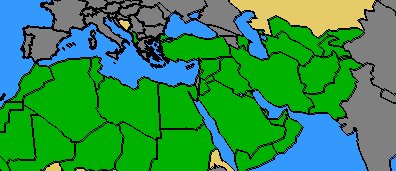
The world map above shows the Muslim-majority countries in green, while the countries marked yellow are those where about half the population are Muslim. The Muslim-minority countries are marked in gray. Most of the world’s 1.4 billion Muslims live in the green and yellow countries while the rest live in the gray countries.

The Muslim-majority countries form an almost contiguous land mass of an approximate area of 12 million square miles. If you observe closely, you will notice a Muslim-minority country squarely placed in the midst of the Muslim countries. If you cannot observe this anomaly of a country in the map above, then the close-up below will show it clearly right in the center of the picture.


This excuse for a country is called Israel, a land with an approximate area of 8 thousand square miles and population of about 7 million. This Muslim-minority country sitting right in the heartland of the Muslim world does stick out like a sore thumb, doesn’t it? Indeed, it’s been there since only 1948. Its creation was an opportunistic side-effect of the post-traumatic stress disorder suffered by the post-colonial, post-world-war Muslim lands. Israel’s expulsion of Palestinians from their land and subsequent state terrorism upon its neighbors has effectively stripped Israel of the right to defend itself. I, for one, was wont to believe that we could live peacefully with an Israel that was cut down to its proper size. But given that history has amply proved that this country’s existence as a sovereign state is a threat to the very concept of peace, I will deduce that the world would be better off without it.

Woe to the rulers of the Muslim countries for being tacit partners in the ongoing high crime being committed against humanity. Whatever happened to 1.4 billion people?


Update (7th Jan 2009): I found this article in The Guardian to be a balanced and informative account of the Israeli predicament.

Tuesday, July 18, 2006

Wake Up, Muslims ...

We all take pride (don’t we?) in how Dr Michael Hart chooses to rank Prophet Muhammad – peace be upon him – as Number One in his book, The 100: A Ranking of the Most Influential Persons in History. Dr Hart starts his book with the following words.

My choice of Muhammad to lead the list of the world’s most influential persons may surprise some readers and may be questioned by others, but he was the only man in history who was supremely successful on both the religious and secular levels.

Of humble origins, Muhammad founded and promulgated one of the world’s great religions, and became an immensely effective political leader. Today, thirteen centuries after his death, his influence is still powerful and pervasive.


I agree. But the question that revolved in my mind when I first read these words some fifteen years ago was,

“If Prophet Muhammad – peace be upon him – was the most influential person in history, then why is there only one Muslim name figuring in the other 99 names?”

(This name being Syedna Umr ibn Khattab – may God be pleased with him - the Second Caliph amongst the Khulafa Rashideen. I will write more about him, insha’Allah, in the future. Strictly speaking, the Prophets Moses and Jesus – alaihum us salam – who are also on the list, were also Muslims, but we are talking here about the Ummah of the Prophet Muhammad – peace be upon him.)

This is a very important and crucial question, since it is very strange that a man – a Prophet – tops a list of influential persons, and none (except one) of the billions of people strongly influenced by him manage to make it to the top hundred. After all, we’ve always been a sizable portion of the World’s population and today we number a quarter-and-a-billion – that’s a quarter of humanity. Of course, we could cry foul and say that Dr Hart has been prejudicial in his assessment, but I don’t think so, since he has been honest enough to place Prophet Muhammad – peace be upon him – at Number One even though he knew it would go against the wishes of some of his readers.

The answer to this question lies in the fact that our long history could be divided into a first millennium of relative success followed by a half-millennium of downfall. For the past 500 years, we have been moving downhill and today we have probably reached the nadir of our 1,500-year career. The first millennium of success brought forth such an overwhelming list of influential names that to name only a few would be to do injustice to the others. I would refer my reader to the website, Muslim Heritage, to learn more about this oft-forgotten period of World History.

But it is our incredible downfall in the past half-millennium that has made us lose the influence that our worthy predecessors had on people. If we have forgotten even the names of our worthy predecessors, then why would Dr Hart care to include them in his list of the most influential persons in history? It is no small matter that Dr Hart says,

Today, thirteen centuries after his death, his influence is still powerful and pervasive.

Notice his use of the word, still. This is a glowing tribute to the Holy Prophet – peace be upon him – since even though many of the people of his Ummah have fallen into moral and intellectual bankruptcy for the past five hundred years, his influence nevertheless is still powerful and pervasive.

I wish there were more of us in that list. Any volunteers?

Friday, July 14, 2006

The US – Israel Axis of Evil ...

Lessons to be Learned From 66 U.N. Resolutions Israel Ignores appeared in the Washington Report in March 1993, so the statistics may be out of date, but the article makes for a fairly balanced and concise view of the whole issue. I would suggest you read the whole article but here are a few excerpts to whet your appetite.

Like former Secretary of State James Baker's repeated assertion that both sides must want peace for it to occur, the Clinton-Rabin agreement ignores the sorry record of the 26 years since Israel's conquest of the West Bank, Gaza, East Jerusalem, and the Golan Heights. During that period Israel has unequivocally demonstrated that it does not want peace in exchange for territory.

However, the Israeli-Egyptian peace treaty was unique. It came at the expense of the Palestinians, which was by Israeli design, and in exchange for Sinai, to which Israel never laid claim. Moreover, Israel received in return for signing the peace treaty with Egypt commitments from the U. S. that have now reached a level of economic and military aid unsurpassed in our history.

The result is that Israel has managed to retain what it has wanted most: East Jerusalem and the West Bank. After so many diplomatic initiatives, it seems fair to conclude Israel does not want peace on any terms but its own.

An end to expulsions is only the latest demand of the international community on Israel, whose defiance goes back to its very beginnings. There remain on the books of the United Nations a collection of resolutions criticizing Israel unmatched by the record of any other nation.

The core issues, as contained in resolutions passed before 1967, remain the Palestinian refugee problem, the status of Jerusalem, and the location of Israel's boundaries. These are the basic issues. They spring from 1948, not 1967.

The early U.N. resolutions call for Israel to repatriate or compensate the original 750,000 refugees of 1948-9 and to renounce Jerusalem as its capital and regard it as a corpus separatum, an international city dominated by neither Arab nor Israeli. (The U. S. position on Jerusalem is slightly different and, not surprisingly, closer to Israel's. It says Jerusalem should not be a divided city and its final status should be decided by the parties.) Finally, the original U.N. partition of Palestine awarded Israel an area only about three-quarters of its current official size. Israel's increase was gained at the expense of the Palestinians in the earlier conquests of 1948.

Other unreconciled issues from this earlier period include such sticky situations as a demilitarized zone that Israel had shared with Syria near the Sea of Galilee. Israel forcefully and unlawfully occupied this zone in the 1950s and 1960s, in defiance of its 1949 armistice with Syria.

Aside from the core issues—refugees, Jerusalem, borders—the major themes reflected in the U.N. resolutions against Israel over the years are its unlawful attacks on its neighbors; its violations of the human rights of the Palestinians, including deportations, demolitions of homes and other collective punishments; its confiscation of Palestinian land; its establishment of illegal settlements; and its refusal to abide by the U.N. Charter and the 1949 Fourth Geneva Convention Relative to the Protection of Civilian Persons in Time of War.

In 29 separate cases between 1972 and 1991, the United States has vetoed resolutions critical of Israel. Except for the U.S. veto, these resolutions would have passed and the total number of resolutions against Israel would now equal 95 instead of 66.

Such a list of resolutions passed and resolutions vetoed is unparalleled in United Nations history. The list in itself forms a stunning indictment of Israel's unlawful and uncivilized actions over a period of 45 years and of America's complicity in them.

Yet references to this damning record are totally absent from the vocabularies of American leaders as they go about saying they are seeking peace.

Tuesday, June 06, 2006

HIV, AIDS, Stigma, and Discrimination ...

Would that we Pakistanis could learn the maxim:

“Hate the sin, not the sinner”

The stigma and discrimination against HIV/AIDS isn’t going to end until we follow this maxim, but it will take a revolution of sorts if we want people to think the way this maxim wants us to think. This revolution will have to begin with you. But you got to realize that HIV/AIDS isn’t the only stigma in Pakistan. All sorts of things become a stigma in my beloved country, for example:
· You are stigmatized if you are black in color (I am talking about color here, not race).
· You are stigmatized if you are poor
· You are stigmatized if you belong to a lesser caste
· You are stigmatized if you suffer from a mental disorder (schizophrenia, bipolar disorder, depression, etc)
· You are stigmatized if you are “low” in “status”
· You are stigmatized if you are infertile (this holds true for both men and women, but especially for women)
· You are stigmatized if you are ugly

I speak from personal experience in a public health setting. Many people would try to hide a family member’s mental illness or the fact that their child is an adopted one and not their biological child. Most poor people will take loan and spend at least a hundred thousand rupees on their daughter’s wedding only to save them from being stigmatized. If you are an infertile woman, then the people around you will give you less respect. If you belong to a lesser caste, you would wish you could lie about it. If your dad were a sweeper at the hospital, you would work your way out of this by telling people that your father is “employed” at the hospital.

Historically speaking, this stigmatism that has pervaded all strata of Pakistani society was (and still is) the mark of Hindu society. Our one-and-a-half-millennium long affair with the Hindu culture gave us this gift of stigmatization. Now it is time for us to throw it into the dustbin.

Pakistani society is a sexually corrupt society (yes, it is) sitting at the brink of a general HIV epidemic. While we are expecting the numbers of HIV-infected persons to rise in the coming years, I am not foreseeing any amount of reduction in stigma and discrimination against HIV/AIDS until you and I start caring for the HIV-infected person. Till then, the people living with HIV/AIDS will have to live in Hell.

Tuesday, April 11, 2006

Happy Birthday, our Beloved ...

Allama Iqbal, may God have mercy on him, said it all when, while passing around the Arabian peninsula on a sea journey, he said,

I wish I were a grain of sand in the desert of Arabia. The winds would blow me from one place till I would come and rest in another place in the desert. Then the winds would blow me from that place too and I would come to rest in yet another place ... ”

I guess I can’t write a better article at the occasion of the birthday of the Beloved, peace be upon him, than these few lines.

Salla Allah o Alaihe Wa Sallam

God bless you all and have fun.

Sunday, April 02, 2006

Who Said I Wasn't There ... ?

Who said I wasn’t there?

I was the dust that you threw in their eyes
I was the pillar that you leaned against
I was the mule that you rode upon
I was the tree that prostrated to you

Who said I wasn’t there?

I was the sandal underneath your feet
When they were hitting you with stones
I am the one who took you away from them
Then God sent the blessed shower of blood
So that it would be difficult to separate us

Who said I wasn’t there?

Thursday, February 16, 2006

A Call to Prevent a Clash of Civilisations ...

Shaykh-ul-Islam Prof. Dr. Muhammad Tahir-ul-Qadri is taking up the issue of the publication of the caricatures of the Prophet Muhammad (SAW) with the UN, EU, OIC, governments of all member states of the UN and with all embassy missions in Islamabad. As part of this diplomatic drive, he will send a detailed memorandum to all of these concerned parties all over the world, including world human rights organisations. The text of the memorandum is given below:

A Call to Prevent a Clash of Civilisations:

The world is facing yet another challenge following the world-wide controversy caused by the publication of blasphemous and defamatory caricatures of the Holy Prophet (PBUH) in some European newspapers. The failure of governments to address this situation has allowed it to spread all over the world, with no end in sight. This situation has been unnecessarily allowed to spiral out of control and has threatened the concept of peaceful co-existence. If not addressed, it can lead to a potential clash of not only civilisations but religions and societies as well.

This memorandum aims to put the issue in perspective and to propose realistic and practicable measures to address it. Much of this debate has focused on the 'right of freedom of expression' with its defenders advocating the sacredness of freedom of speech which needs to be upheld no matter what the consequences. However in reality the issue is not one of curtailing the right to freedom of expression since this is a right that is not absolute and no one can claim so. Rights are reciprocal and their enforcement is interdependent on other fundamental rights. To insist that a right is absolute is erroneous since such a right can infringe other basic human rights. Every country that claims to be part of the 'civilized and democratic' world has put its own limits on freedom of expression in the interests of society in order to maintain a certain level of human behaviour, be it based on local norms and customs, culture or religion but in essence to protect the dignity of their moral and religious, social, and societal values.

So to suddenly create an outcry that the right to freedom of speech is being undermined by Muslim protests is clearly a fallacy. The free propagation of child pornography for instance or the incitements of religious or racial hatred in the media is banned in many countries and quite rightly so. In many European countries it is a crime to deny the holocaust, being a criminal offence in Austria, Belgium, Czech Republic, France, Germany, Israel, Lithuania, Poland, Romania, Slovakia and Switzerland, and is punishable by fines and a jail sentence. When the British newspaper, The Independent (27 January 2003) depicted the Prime Minister of Israel, Ariel Sharon eating the head of a Palestinian child while saying, ' What's wrong, You've never seen a politician kissing babies before', this caused an uproar in Israel and other parts of the world raising tempers especially in the Jewish and Israeli community around the world. Whatever the matter of that caricature, the uproar was a natural reaction of a people for their leader. More recently when the Italian prime minister Silvio Berlusconi compared himself to Jesus Christ the Vatican including Italian politicians immediately expressed shock and anger at these comments. A senior Catholic Church official added, "I know he will say he was speaking in jest but such things should not be spoken of in jest." The issue here is not one of curtailing freedom of expression but objecting to the ridicule and insult towards the sacred elements of an entire civilisation.

There is also a law of defamation normally under the Law of Tort that can lead to an individual being compensated for offence caused. The absolute right to free expression is curtailed in order to balance the rights of an individual. In the same way an act that causes offence to a whole community can never be justified under the banner of freedom of speech. Moreover in many countries it is illegal or at least discouraged to degrade or abuse the constitution or certain national institutions such as the army, courts of law, or parliament. Contempt of court also exists all over the world which severely limits freedom of speech, violation of which can lead to imprisonment. If the right to freedom of expression is absolute, why are there no objections to laws such as these?

To give respect to an individual's honour and dignity is a fundamental human right protected by law as is the prohibition on blasphemy and defamation as well as the right to religious freedom. The UN Charter, Constitutions and Laws from many countries provide protection to these rights.

The UN Charter recognises this right in Article 1(ii):

"To achieve international co-operation in solving international problems of an economic, social, cultural, or humanitarian character, and in promoting and encouraging respect for human rights and for fundamental freedoms for all without distinction as to race, sex, language, or religion."

It is also recognised in the European Convention on Human Rights Article 9:

"Freedom to manifest one's religion or beliefs shall be subject only to such limitations as are prescribed by law and are necessary in a democratic society in the interests of public safety, for the protection of public order, health or morals, or for the protection of the rights and freedoms of others." The constitution of the USA, Amendment I of Bill of Rights states:

"Congress shall make no law respecting an establishment of religion, or prohibiting the free exercise thereof; or abridging the freedom of speech, or of the press; or the right of the people peaceably to assemble, and to petition the government for a redress of grievances."

Some US states have blasphemy laws on their statute books. The U.S state of Massachusetts General Laws states (chapter 272 section 360) "Whoever wilfully blasphemes the holy name of God by denying, cursing or contumeliously reproaching God, his creation, government or final judging of the world, or by cursing or contumeliously reproaching Jesus Christ or the Holy Ghost, or by cursing or contumeliously reproaching or exposing to contempt and ridicule, the holy word of God contained in the holy scriptures shall be punished by imprisonment in jail...

Other countries having blasphemy laws are:

1. Austria (Articles 188, 189 of the criminal code)
2. Finland (Section 10 of chapter 17 of the penal code)
3. Germany (Article 166 of the criminal code)
4. The Netherlands (Article 147 of the criminal code)
5. Spain (Article 525 of the criminal code)
6. Ireland: Article 40.6.1.i of the constitution of Ireland provides that the publication of blasphemous matter is an offence. Prohibition of Incitement to Hatred act 1989, this includes hatred against a group on account of their religion.
7. Canada Section 296 of the Canadian Criminal code. Offence against the Christian religion is blasphemy.
8. New Zealand Section 123 of the New Zealand Crimes Act 1961

Churches for instance hold sanctity in the Christian world and are protected under the constitution in some European countries. An example is the constitution of Denmark, section 4 [State Church] which states: "The Evangelical Lutheran Church shall be the Established Church of Denmark, and, as such, it shall be supported by the State." It is evident from the above mentioned laws that freedom of speech is a fundamental right but this right is not absolute. There are hundreds of books and newspaper articles that have been published attempting to criticize Islam and the basic tenets of its faith yet Muslims never object to scholarly debate since they are well aware that this is part of an ongoing debate on Islam and within the tenets of 'freedom of expression'. There have been countless newspaper articles completely misrepresenting Islam, often publishing clear lies and exaggerated stories about Islam and its law yet Muslims are tolerant and appreciate that this is part and parcel of living within societies who claim this to be part of their 'liberal democracies'. However when this right of 'freedom of expression' is abused and the most sacred elements of Islam are deliberately insulted then this will definitely create great unrest among Muslims around the world. By depicting the Holy Prophet of Islam (PBUH) as wielding a knife and wearing a bomb disguised as a turban on his head is a deliberate attempt to insult and stir up controversy, presenting him and his followers as violent terrorists. Another caricature portrays him as supporting suicide bombers and saying "Stop, Stop we have run out of virgins". How can such caricatures be justified under the banner of free speech? Moreover these caricatures were not printed within a vacuum but in an environment of an anti-Muslim bias where tensions were already running extremely high within the Danish community and indeed throughout Europe. Only recently the Queen of Denmark had made controversial remarks stating that: "We have to show our opposition to Islam and we have to, at times, run the risk of having unflattering labels placed on us because there are some things for which we should display no tolerance."

Moreover many countries have passed anti-terrorist legislation, severely restricting the civil liberties of individuals, with the legislation drafted in a manner that is clearly aimed at focusing upon Muslims in the countries concerned. There is a strong feeling that a substantial minority is being continually abused and misrepresented in the mass media through the portrayal of negative images not based upon reality, and then subjected to humiliating checks and procedures when going about their lives on a daily basis, all in the name of freedom of speech and national interest. It is thus highly surprising that the sacred elements of its faith are ridiculed just in the name of freedom of expression and speech knowing that the reactions will be extremely tense. There is no doubt that the publishing of these caricatures by the newspapers involved was an exercise to demonstrate control and power directed against Muslims, either subscribe to our culture and way of living or suffer the consequences and be ridiculed and debased.

Realising the significance of this right some world dignitaries have condemned the publication of these caricatures and have emphasised the restriction of the right of the freedom of speech too.

Kofi Annan: "I also respect the right of freedom of speech. But of course freedom of speech is never absolute. It entails responsibility and judgment." Jack Straw, British Foreign Secretary: "There is freedom of speech, we all respect that. But there is not any obligation to insult or to be gratuitously inflammatory. I believe that the re-publication of these cartoons has been insulting; it has been insensitive; it has been disrespectful and it has been wrong. "There are taboos in every religion. It is not the case that there is open season in respect of all aspects of Christian rites and rituals in the name of free speech. Nor is it the case that there is open season in respect of rights and rituals of the Jewish religion, the Hindu religion, the Sikh religion. It should not be the case in respect of the Islamic religion either. We have to be very careful about showing the proper respect in this situation."

The US State Department: "These cartoons are indeed offensive to the belief of Muslims." Spokesman, Kurtis Cooper, said: "We all fully respect freedom of the press and expression but it must be coupled with press responsibility. Inciting religious or ethnic hatred in this manner is not acceptable." Philippe Douste-Blazy, French Foreign Minister: "The principle of freedom should be exercised in a spirit of tolerance, respect of beliefs, respect of religions, which is the very basis of secularism of our country."

Vatican cardinal Achille Silvestrini condemned the cartoons, saying Western culture had to know its limits. It is thus clearly apparent that using freedom of speech to imply that there are no limits to what one can say or do is a myth. An act that offends the religious and moral values of a community such as solidarity, integrity and sanctity, resulting in endangering the peace, cannot be regarded as a right to express ones freedom of speech. Islam too teaches the principle of tolerance and co-existence, to live and let live. It discourages the defamation of other Gods and religious symbols teaching respect to mankind. (Al-Quran: Al-An'am: 6:108). Islamic Law lays great emphasis on the security, dignity and respect of all other religions together with their beliefs without any discrimination.

If internationally recognised principles of tolerance and co-existence are put aside and moral and religious values are dishonoured then the present situation will worsen and the prevailing tensions will intensify. Europe considers itself to be an educated and civilized society but its response to the gross infringement of the basic right to religion of one of its minority communities has become un-understandable. There needs to be some mechanism to put an end to these horrific occurrences which may prove a potential threat to world peace. Those who advocate that the right to freedom of speech is being eroded and any restraints upon it cannot be tolerated must look within their own 'democratic societies' and the extent to which their civil liberties have been eroded through the recent anti-terrorist legislation. These are the measures that have curtailed the rights and liberties of individuals and have much more serious implications which need to be addressed. Muslims are feeling alienated and targeted thus when newspapers begin to ridicule the most sacred elements of their faith, reactions will inevitably be high. If the publication of the caricatures is not taken seriously and steps are not taken to resolve the situation, then it can generate socio-political and economic crises which may lead to a conflict between civilizations and between nations.

These are the reasons behind the anger against the publication of these condemnable caricatures and the anger at the disregard shown by the governments towards the rightful protests of the Muslim world against the offence. 1.25 billion Muslims all over the world have been deeply insulted and instead of creating moves to resolve the matter, the act is being continuously justified prolonging world-wide unrest.

In order to solve this international issue and dissolve the serious tension it has caused, I propose the following solutions be implemented:

1. All newspapers that have published the caricatures must unreservedly apologise and withdraw their publications.
2. Clear legislation needs to be passed by all Governments which balance the right to freedom of speech with the rights of individuals and communities that their sacred beliefs should not be insulted and ridiculed.
3. All Governments should then ensure that any such legislation is enforced through the due process of the law and this type of incitement and ridicule never happens again.

I expect that common sense will prevail and responsible leaders will rise to the occasion and repair the damage that has been done to inter-civilization relations. I also expect that the concerned leaders of the countries will display leadership and bravely extend cordiality to the Muslims of the world.

Prof. Dr. Muhammad Tahir-ul-Qadri
Founding Leader Minhaj-ul-Quran International (MQI)
Chairman Pakistan Awami Tehreek (PAT)